
Indra Air Traffic at Airspace World 2026: technological innovation to transform air traffic management
Our solutions incorporate AI, data analytics, augmented reality and advanced digital platforms
6 reading time
The international Airspace World 2026 exhibition, to be held in Lisbon from 26 to 28 May 2026, has established itself as the world’s leading global meeting point for airspace management and aviation technologies. Against this backdrop, Indra Air Traffic will showcase a broad portfolio of innovative solutions, reinforcing its leadership in the digital transformation of air traffic and its position as a global reference provider of Air Traffic Management (ATM) systems.
A vision: a safer, more efficient and more sustainable sky
Indra Air Traffic builds on a firmly established leadership position in the sector. Its technologies for air traffic management, communications, navigation, surveillance and aeronautical information are deployed in more than 90% of countries worldwide, impacting over 85% of global passengers.
On this solid foundation, Indra Air Traffic is driving the evolution of the sector through three key pillars:
- Digitalisation of air traffic
- Integration of artificial intelligence
- Large-scale operational sustainability
This technology strategy takes tangible form at Airspace World through solutions that embed artificial intelligence, data analytics, augmented reality and advanced digital platforms across the entire air traffic lifecycle.
Linkia: the new digital platform redefining air traffic management
One of the major highlights at Airspace World will be the Linkia Digital Platform, powered by IndraMind and officially launched during the event.
Linkia is the core digital infrastructure for the future of air traffic management, introducing a radical shift away from traditional ATM architectures:
- It replaces isolated systems with a standardised service layer
- It enables agile, secure and scalable application deployment
- It natively integrates regulatory and cybersecurity requirements
- It facilitates the progressive incorporation of artificial intelligence

Instead of separate infrastructures for each application, Linkia provides a shared platform model that accelerates innovation and enhances interoperability, fully aligned with the vision of the European Digital Sky.
Digital towers and simulation: the future of air traffic control
Indra Air Traffic will also demonstrate how air traffic control is evolving towards more flexible and resilient models through two key technologies:
Digital Tower
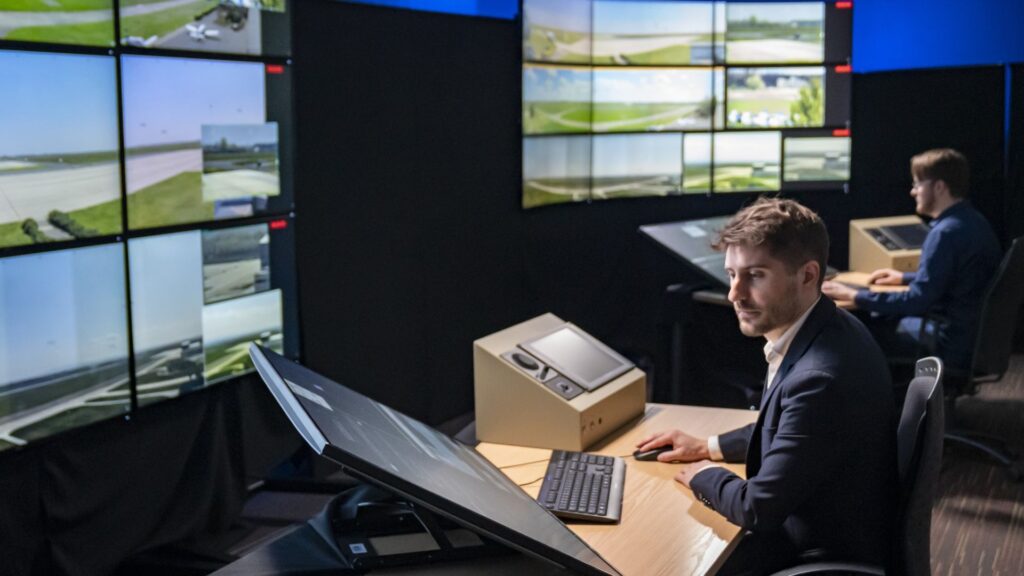
The digital tower concept enables airport operations to be managed from centralised or remote locations by combining:
- High-definition visualisation
- Sensor fusion
- Advanced IP-based communications
This architecture not only optimises operations at regional airports but also acts as a contingency and back-up system, significantly enhancing operational continuity.
MicroNav Simulation Suite
This high-fidelity air traffic control (ATC) simulation system has become an essential tool for:
- Controller training
- System validation
- Testing new operational concepts
By reducing risk, improving training quality and accelerating the deployment of new technologies, simulation plays a critical role in safe and efficient modernisation.
Advanced automation: end-to-end air traffic management
In the field of ATM systems, Indra Air Traffic will present solutions such as:
ManagAir ATM Suite
A comprehensive automation system covering all phases of flight (gate to gate), incorporating:
- 4D trajectory-based air traffic management
- Advanced automation functions
- An open and scalable platform
This approach increases capacity, safety and efficiency, enabling progressive modernisation without operational disruption.
iTEC SkyNex
Developed in collaboration with the iTEC alliance, this next-generation system introduces:
- Trajectory-based operations
- Enhanced interoperability
- Advanced automation capabilities
It represents a key pillar in the large-scale digital transformation of ATM worldwide.
InNOVA Tower System
This is a modular and scalable platform that integrates key capabilities such as A‑SMGCS (Advanced Surface Movement Guidance and Control System), together with tower and approach functions within a unified architecture. It can be deployed in conventional towers, contingency centres or digital towers, delivering enhanced flexibility and operational resilience.
During the exhibition, Indra Air Traffic will demonstrate the A‑SMGCS system being developed for Nice Airport, in collaboration with the French ANSP DSNA. This solution is designed to meet the demanding requirements of the European CP1 (Common Project One) programme, which defines advanced standards to improve safety, efficiency and sustainability at Europe’s major airports.
The system deployed in Nice is based on the version already being implemented at Paris Charles de Gaulle Airport, one of Europe’s largest hubs. This approach illustrates how Indra Air Traffic transfers proven solutions from highly complex environments to new airports, ensuring technological consistency and accelerating infrastructure modernisation.
Integrating drones into the airspace
Indra Air Traffic is also addressing one of the sector’s major challenges: the integration of new airspace users. In this area, its UTM (Unmanned Traffic Management) platform enables:
- Flight planning and authorisation
- Real-time monitoring
- Integration with conventional ATM systems
All of this is delivered within an interoperable model aligned with European U‑space regulation. The UTM platform positions itself as a cornerstone of a collaborative and connected ATM ecosystem.
Communications and information solutions
Indra Air Traffic’s technology portfolio is further strengthened by communications and aeronautical information solutions that underpin the operational backbone of the ATM system:
- Garex VoIP: fully digital voice communications for towers and control centres
- Park Air Radio: high-availability radio systems for civil and military environments
- AIM (Aeronautical Information Management): digitalisation of aeronautical information
- SWIM (System Wide Information Management): standardised data exchange, enhanced interoperability and improved situational awareness
Critical infrastructure: airports
In the airport domain, the Airport Operations Centre (APOC) solution provides integrated, real-time airport operations management.
At Airspace World, Indra Air Traffic will also showcase technologies based on video analytics and artificial intelligence to monitor processes such as aircraft turnaround on the apron, improving efficiency and on-time performance.
Innovation with real impact on the industry
Beyond individual solutions, Indra Air Traffic’s presence at Airspace World reflects its active role in major international programmes such as SESAR, as well as its involvement in projects addressing:
- Advanced automation
- Scalable digital platforms
- Remote and virtual operations
- Data-driven aviation safety
This demonstrates a clear commitment to transforming not only technology, but also the operational models of the air traffic management sector.
Indra Air Traffic: leading the future of airspace
Indra Air Traffic’s participation in Airspace World 2026 is more than a technology showcase—it is a strategic statement. The future of air traffic will be digital, interoperable, automated and data-driven.
From platforms such as Linkia to solutions for drones, digital towers and airport management, Indra Air Traffic is building the foundations of a safer, more efficient and more sustainable airspace ecosystem.
At a time of increasing complexity for the aviation sector, its proposal shows that innovation—when applied with vision and experience—can profoundly transform the way we fly and manage the skies.
One of the key highlights at Airspace World will be the Linkia Digital Platform, powered by IndraMind and officially launched during the event. Linkia is the core digital infrastructure for the future of air traffic management, introducing a radical shift in traditional ATM architectures.
Recommended for you
Related Articles

Linkia: A digital platform natively designed for a new era of air traffic management

If satellite-based navigation is more efficient, why do conventional navaids remain essential?

UTM: why is a drone traffic management system necessary?


Startical: why transoceanic flights will become safer and more efficient


The world’s most advanced remote digital tower is in…


What is the Single European Sky and what is Indra’s role?