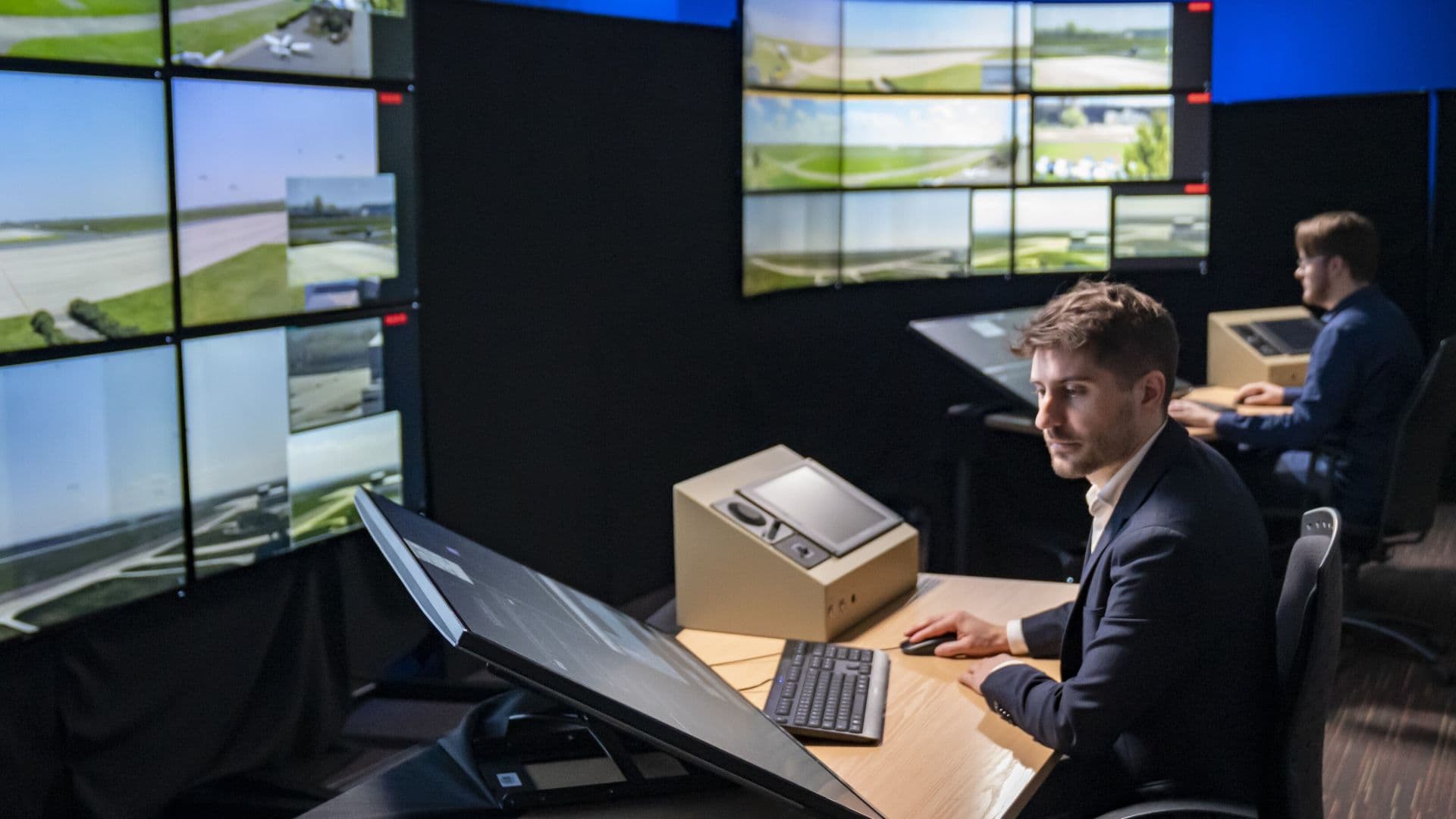
The world’s most advanced remote digital tower is in…
Budapest has become the first international airport fully managed by controllers located outside the conventional physical tower
4 reading time

A Remote Digital Tower is an advanced system that enables controllers to manage an airport’s air traffic from a location other than the conventional physical tower, using 4K cameras, sensors, and digital technology. It provides a high-quality panoramic view, integrates real-time information on screens, and uses artificial intelligence to automatically detect anomalies or risks.
It can also control multiple airports from a single centre, enhancing safety and operational efficiency while reducing costs by removing the need for a physical tower—a solution widely adopted by airports with low traffic density.
However, this is not always the case. Budapest has become the first international airport in a European capital fully managed by air traffic controllers located outside the conventional tower.
The system allows HungaroControl, Hungary’s air navigation service provider, to monitor both air and ground traffic remotely. This is achieved through a bidirectional integration of Indra’s IRTOS visual and augmented reality solution and the integrated tower and surface air traffic control solution (A-SMGCS) known as InNOVA.
The operation combines a shared high-resolution 4K video wall, individual visual screens, and fully integrated ATM displays for tower and surface control. The configuration is designed for ease of use, maximising situational awareness and supporting decision-making.

This pioneering project reflects a broader shift in the aviation industry towards more flexible, efficient, and sustainable operations. By eliminating the need for a traditional control tower, airports can optimise space, reduce costs, and improve operational efficiency.
Seamless integration of advanced surface surveillance
The advanced technology platform fully integrates a natural 4K view of the airport area with the IRTOS visual system, capturing images from seven viewpoints and applying augmented reality, identification, traceability, and automated processing functionalities. These are combined with the most advanced air traffic management system on the market, including ground (A-SMGCS) and air surveillance.
Based on Indra’s InNOVA ATM system and IRTOS, HungaroControl operators benefit from advanced automation and airport safety networks aligned with EU Common Project 1 (CP1) regulations, which aim to improve capacity and fluidity by modernising and harmonising air traffic control across Europe.
Key capabilities of the remote digital tower system
- Conflicting ATC Clearance Detection (CATC): Identifies and prevents contradictory ATC instructions.
- Conformance Monitoring (CMAC): Ensures aircraft follow assigned routes and clearances.
- Automated Arrival and Departure Management (AMAN/DMAN): Improves traffic flow and planning.
These functionalities enhance safety, efficiency, and sustainability, supporting the overall objectives of European airspace modernisation.

Enhanced visual awareness and operational safety
Thanks to IRTOS integration, Indra’s platform offers high-quality augmented vision of the airport area, with capabilities such as:
- Zoom: manual or automated examination of critical areas in detail.
- Enhanced night mode: ensures safe operations in low-light conditions.
- Surveillance tags: displayed on video walls or individual monitors, enabling identification and positioning of aircraft before they are visible, thanks to ATM system data integration.
- Redundant object tracking: using visual sources or ATM data to maintain continuous awareness of movements.
- Mobile object identification: based on advanced vision algorithms to reduce errors and support faster decision-making.
Applied to video walls and individual screens, these functions significantly improve controllers’ situational awareness, even in adverse conditions, reducing risks and enhancing decision-making.iencia situacional de los controladores, incluso en condiciones adversas, con lo que se reducen riesgos y se mejora la toma de decisiones.
Complete bidirectional integration of visual and tower/surface control systems
The system deployed in Budapest represents the most advanced level of integration worldwide for this type of solution, enabling seamless operation of functionalities such as:
- Sectorisation of areas from the visual system
- Camera control for zoom or object tracking from the A-SMGCS display
- Integrated tower, runway, and A-SMGCS map within the visual system
- Header monitoring function
- Camera status displayed at tower and surface control positions
HungaroControl is currently training its air traffic controllers and technical staff to operate the new system, with full operational deployment planned for 2026. To support testing and training, Indra has provided a 3D digital simulator that replicates real conditions, enabling realistic training and contingency system testing.
A new standard for capital city airports
The implementation of a remote digital tower at a capital city airport, as in Budapest, demonstrates the maturity and reliability of this technology. It sets a new benchmark for air traffic management, proving that remote operations can meet the demands of high-traffic environments while improving safety and efficiency.
This pioneering project reflects a broader shift in the aviation industry towards more flexible, efficient, and sustainable operations. By eliminating the need for a traditional control tower, airports can optimise space, reduce costs, and improve operational efficiency.
Recommended for you
Related Articles
If satellite-based navigation is more efficient, why do conventional navaids remain essential?

UTM: why is a drone traffic management system necessary?


Startical: why transoceanic flights will become safer and more efficient



What is the Single European Sky and what is Indra’s role?



Linkia: A digital platform natively designed for a new era of air traffic management